Friday, January 30, 2015

Enhancements to DIY iGoogle start page

Read More
I’ve upgraded the DIY “iGoogle” start page.

You can see the latest version here: http://nbe.me/demo

The previous version is here: http://nbe.me/olddemov2

The previous previous version is here: http://nbe.me/olddemo

You can download the source for the page here: http://nbe.me/demo/d.zip

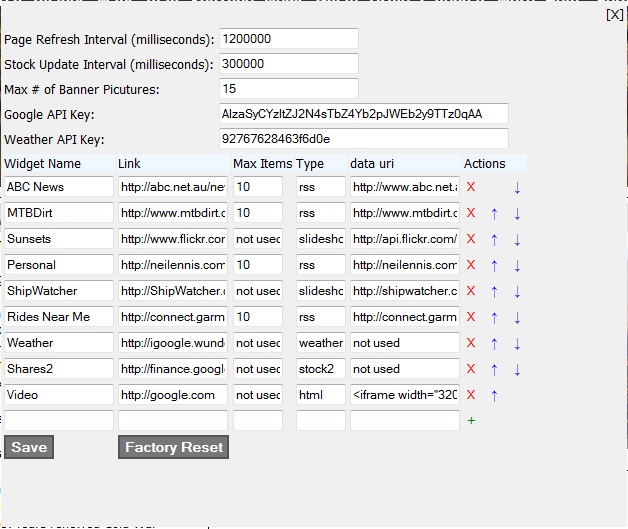
The major enhancement is that you can now embed html into the page – which makes it easy to add Youtube videos, or iFrame widgets.


To add embed code, click on Setup and add a new widget with a type of “html”. In the “data uri” field, paste your embed code. For example, to add a youtube video, you’d paste this code into the “data uri” field:

< iframe allowfullscreen="" frameborder="0" height="auto" src="https://www.youtube.com/embed/DPP1INgPtSs" width="320" >< /iframe >

Make sure you keep the width of any iframes to 320 pixels or less, otherwise the layout of the screen won’t look too good.

Also – if you’re trying out the demo page, you might want to press Ctrl-F5 to clear your browser cache, so the new version gets loaded.

Monday, February 24, 2014

ObSrv: No Longer For Sale

Read More

Thank you for the emails of support and kind donations.


After a few minor changes and exchanges with Google I have managed to rectify the problem relating to inappropriate images on the detail pages.


Because of your kind support, and the resolution of issues with Google, I’ve changed my mind and decided not to sell ObSrv.


I plan to keep it running indefinitely.


If you have any issues, or need support, please leave a message or contact me at:

mail at neilennis dot com


If you’d like to donate to help keep the site running, I’ve added a couple of paypal buttons on the site.


ObSrv: No Longer For Sale

Read More

Thank you for the emails of support and kind donations.


After a few minor changes and exchanges with Google I have managed to rectify the problem relating to inappropriate images on the detail pages.


Because of your kind support, and the resolution of issues with Google, I’ve changed my mind and decided not to sell ObSrv.


I plan to keep it running indefinitely.


If you have any issues, or need support, please leave a message or contact me at:

mail at neilennis dot com


If you’d like to donate to help keep the site running, I’ve added a couple of paypal buttons on the site.


Tuesday, January 28, 2014

ObSrv.com is for sale

Read More

ObSrv.com is a web service which provides image feeds for any subject you like.


The content is updated hourly, allowing you to provide high-quality, relevant graphics for any website, or feed reader.


I’ve been able to maintain this site and host it because of the modest income stream I derive from Google ads that appear on the info pages that are displayed when a website visitor clicks on an image.  This has been great because:


  1. Web publishers didn’t need to pay anything.

  2. The ads didn’t intrude on your site – they only displayed when an interested user clicked on an image.

  3. Clicking on the image redirected to an intermediate site which displayed the ad, and allowed the user to proceed to the original site.


I didn’t have any say on what sort of images web publishers displayed – my only request was that web publishers did not use ObSrv to display adult-related images.


That’s not because I am a prude – it’s because Google prohibits ads on these sorts of sites.


Unfortunately, some people ignored this request, Google cancelled ad serving for the ObSrv site, and now it’s not paying me anything.  I can’t afford to keep it running for free.


So I have decided to sell it.


If you’re interested, please make an offer.  No serious offer will be ignored.


I’m sorry for any inconvenience.  I’m willing to be flexibile to help you out:


If you need access to ObSrv prior to it being sold, please email mail@obsrv.com.  If you’re one of the incredibly generous people who has made a donation to me in the past, or if you would like to make a modest donation, I will send you a temporary URL which will keep images being served to your site until ObSrv.com is sold.


If enough people continue to make regular modest donations I won’t sell it.


What’s a reasonable donation?  I’m flexible, but probably $20-$30 per site per year.  If half a dozen people paid this, I’d keep ObSrv online.


If you want to buy it, here’s what you get:


1. The domain ObSrv.com.  A cool five letter dot com domain – imagine what you could do with it!


2. The ASP.NET and MS-SQL Server Source Code.


3. The data.


4. 12 months hosting for the site until you find somewhere else to host it.


5. 12 months tech support for the source code.  I’m not going to over-promise here.  The source code is well documented.  I’ll answer any questions you have.  I’ll even do minor mods for you – but it has to cut both ways, and the level of support depends on the price at which you buy from me.


About me: Do a Google Search on me: “Neil Ennis”.  You’ll soon see I’ve been around a long time, I keep my promises, and I value long-term business relationships.  I won’t let you down.


Thursday, December 05, 2013

DNS323 Formatting “stuck” at 94%

Read More

DNS-323_sideThe DLINK DNS323 is a network storage device that takes two SATA disk drives,  plugs into your local network, and acts as a file server for media and documents.


We’ve had one for the last 5 years, and it has served us very well.  It’s quick, reliable and easy to use.


We had two 1TB Western Digital “Caviar” drives installed.


Unfortunately, one of those drives failed last night.  I replaced it with a Seagate “Baracuda” 2TB drive.  We’re not running the DNS323 in a “RAID” configuration, so a different type of drive isn’t a problem.


When I booted up the unit with the new drive, the web interface told me it found the new drive, and was it ok to format it?  It assured me my other drive would be ok.


I answered “Yes” and it started formatting the new drive, but it stopped when it got to 94%.


There are a whole lot of articles online about this problem, and people have come up with many and various issues to get around it like using a different browser, clearing out cookes, even formatting the drive on a separate machine.


There was a mcuh simpler solution, however.


A 2TB drive is pretty big.  It takes a long time to format.  It just so happens that on this device, most of the formatting happens when it gets to the 94% mark.


So the easiest solution to this problem is to WAIT. 


Do nothing for an hour.  Eventually it will finish formatting, and everything will be ok.


If you don’t like doing this, feel free to try a different browser, or bury your computer in peat for a couple of hours, or chant incantations for a while.  I assure you whatever you do, if it takes longer than an hour, it will fix the problem.


Well…. it will appear to fix the problem.


Or – just wait.  Let the thing finish formatting.  Then everything will be ok.


Thursday, November 14, 2013

DIY iGoogle Upgrade

Read More

I’ve upgraded the DIY “iGoogle” start page.


You can see the latest version here: http://nbe.me/demo

The previous version is here: http://nbe.me/olddemov2

The previous previous version is here: http://nbe.me/olddemo


Major items:

1. Each widget has its own “Settings” page which allows you to edit settings. Just click on the “settings” button at the top right of any widget:

Widget Settings Button


2. You can add / edit stocks & shares. If you click on the settings button for the stock widget you get a screen which lets you change the existing stock codes, quantities and buy prices.:

Stock Edit Screen

To delete a stock item, click on the red “X” button.

To move a stock item up a line, click on the blue up-arrow (↑)

To move a stock item down a line, click on the blue down-arrow (↓)

To add a stock item, fill in the blanks and click the green “+” button.

To save changes, click on the “SAVE” button.

To cancel changes or close the edit dialog, click on the [x] button at the top right of the window.


3. You can edit the links in the top-bar by clicking on the “*” to the right of the links in the top bar.


4. You can add / edit / remove widgets by clicking on the “Setup” link in the top bar.

setup

To delete a widget, click on the red “X” button.

To move a widget up a line, click on the blue up-arrow (↑)

To move a widget down a line, click on the blue down-arrow (↓)

To add a widget, fill in the blanks and click the green “+” button.

To save changes, click on the “SAVE” button.

To cancel changes or close the edit dialog, click on the [x] button at the top right of the window.

Click “Factory Reset” to clear all your settings and revert back to the original settings that you downloaded from the website.


5. All settings are stored locally on your hard drive using the HTML5 “localStorage” facility. This is like a cookie, only bigger. The page settings were over 4,000 bytes in size, so would not fit in a cookie which officially can’t be larger than about 4,000 bytes. Local storage can be as large as your hard drive, so there are no storage limits, and the security / privacy settings are the same as for cookies.


You can download the source code here:

http://nbe.me/demo/d.zip


If you plan to use the weather widget, please change the “Weather API Key” in the “Setup” screen. Since lots of people are using this start page, the current API key will run out of API calls each day and won’t work. There are instructions on getting your own keys here:

http://tech.neilennis.com/index.php/diy-replacement-for-igoogle/


As with all previous versions, you don’t need to load this start page on a web server. It will run fine from a folder on your computer. Just unzip the zip file, and click on index.html.


If you plan to put it on a public web server, you might want to password protect it with a htaccess file to protect your privacy.


Please try it out and let me know how you go.


Thursday, October 24, 2013

DIY Replacement for iGoogle.

Read More

iGoogle will be gone at the end of this month.


I love iGoogle. It was free, convenient, and worked well. But because it was provided free by Google, it’s their right to pull the pin on it if they want to.


This event made me realize that any free service online may be cancelled. So if you don’t want the inconvenience of losing a free service that you love, you’re best off doing it yourself.


Here’s my modest attempt at writing my own iGoogle replacement page.


You can download the source for the page here: http://nbe.me/demo/d.zip


When you’ve downloaded the zip, you can unzip it to your own hard drive, or put it on a web server somewhere.


Before you start using it, you need two things: A Google API Key, and a Wunderground API Key.


Google API Key


1. Go to https://code.google.com/apis/console

2. If prompted, click on the “Create Project” button

3. Click on the “Services” button and change the status of “Custom Search API” to “ON”. Accept the terms.

4. Click on the “API Access” Link

5. In the “Simple API Access” section, click on “Create new Server key…”

Leave the “IP Address” box blank, and click “Create”

6. Copy the “API key”. This is your “Google Key” that you need to put in your index.html

7. Edit “index.html” and scroll to line 21 or there abouts. It will say something like:


var GoogleKey = “XXaaAaAAaAaAA9A9a9aaaaaAAA99a9aaaaA9AAA“; // Get your Google key here: https://code.google.com/apis/console


8. Replace the red key with your Google API key.

9. Save the index.html file


 Wunderground Key


1. Go to http://www.wunderground.com/weather/api/

2. Click on “Sign Up for FREE”

3. Create your free account

4. Activate your membership

5. Login to Wunderground

6. Click on “Explore My Options”.

7. Select “Developer” option ($0) then click “Purchase Key”

8. Complete the questionaire honestly.

9. Click on the “Key Stettings” tab.

10. Copy the “Key ID”. This is your “Weather Key” that you need to put in your index.html

11. Edit “index.html” and scroll to line 23 or there abouts. It will say something like:


var WeatherKey     = “99999999999aaaaa“; // Get your API key here: http://www.wunderground.com/weather/api/


12. Replace the red key with your Weather key.

13. Save the index.html file


You might want to change “WeatherCountry” and “WeatherCity” to reflect your home country and city.


Tuesday, June 18, 2013

ObSrv Bug Fix – Please read

Read More

I’ve fixed a bug with ObSrv that was causing empty image feeds to appear.


There is a long term problem that we need to address, and I need your help to sort it out.


The problem is that Google is limiting the number of image searches that ObSrv can do to 100 per day. The problem is that once we exceed this limit, no images are returned and you get a blank feed.


I’ve temporarily fixed this problem by changing the image search provider. I’m not saying which, as I don’t want to cause any more waves.


But eventually they’ll start blocking excessive image searches as well.


So I’m considering changing ObSrv to require you to supply a Google API key. It won’t be hard to do. All yu need to do is go to the Google Code API console, log in (or create an account) and request an API key.


Future versions of ObSrv will require you to enter that API key as part of the Feed URL.


For now, you don’t need to do anything. Everything should be working perfectly. Your images should come through as expected.


I’m just alerting you to what may have to happen, and I’d like your feedback please.


You once might have had a feed URL that was something like: http://obsrv.com/General/ImageFeed.aspx?mountain+wallpaper


But I’m suggesting we change that to something like: http://obsrv.com/General/ImageFeed.aspx?mountain+wallpaper&APIKEY=[your API KEY]


This way, any ObSrv feed requests will be linked to your API KEY and not mine. And (provided you don’t go over 100 requests per day) Google won’t hassle you. This shouldn’t be a problem. Image feeds don’t update that often. Even if you refreshed the feed every hour you’d be able to have four separate feeds and stay under the limit.


If you exceed Google’s limit, they’ll probably want you to open up a commercial account with them and pay them something. This has nothing to do with me. I’m not asking for your money – I’m just explaining how Google deals with people who use their resources in an unusual way.


Please leave a comment, or email me, and let me know your thoughts.


The challenge we face is that Search Engines are a moving target. Writing a web service like ObSrv that keeps up with this target is difficult, but not impossible.


Monday, March 12, 2012

Windows Home Server 2011

Read More

I recently upgraded from Windows Home Server (WHS) to Windows Home Server 2011 (WHS2011).  My old WHS machine was dying, and I was attracted to idea that WHS2011 was a 64 bit OS, and would hopefully perform better.  I installed WHS2011 onto a 64 bit VMWare virtual machine with 4GB ram, a 200GB virtual for the OS, 3TB storage on an external USB HDD and a 100 GB virtual disk to backup the OS.


Incidentally, the OS only formatted up a 2GB partition on the 3GB drive, leaving a separate 1TB partition unused.  I formatted this up later and added it to the pool.


I encountered several problems, but have overcome them all, and am very happy with the result.


1. WHS provided Drive Extender Technology, but WHS2011 does not.


A cool feature about the original WHS was that you could add extra storage to the box on the fly, and WHS would allocate it to one large storage pool.  So rather than having a bunch of disparate disks of all different sizes, they’d all appear as one huge drive.


This feature was dropped from WHS2011.


That meant if one of my drives filled up, and I wanted to add more storage, it would appear in the system as a separate drive, and I’d have to alter my backup plans to use the new drive.


I got around this problem by installing DriveBender – a WHS2011 add-in which allows me to dynamically manage the size of my storage pools, provides redundancy, and makes managing a bunch of drives a lot easier.  It only cost me $40, which (even for a tight-wad like me) was money well spent.


2. Disk Errors caused backups to fail


After a while, the USB drive started to fail.  WHS 2011 reported that the Windows Server Client Computer Backup Service was not running.  I tried to start it manually, but it failed.  The event log gave the following error:

“ReadHeader File: D:\ServerFolders\Client Computer Backups\Commit.dat Error: Unable to complete the requested operation because of either a catastrophic media failure or a data structure corruption on the disk.”


To get around this problem, I used DriveBender to add a second (2TB) USB drive to the pool. I then used DriveBender to remove the faulty (3TB) UDB drive from the pool.  Removing the faulty drive took about 36 hours.  Basically DriveBender had to check the CRC of every file on the drive before copying it.


After removing the faulty drive, I stil received the same error, so I did a “repair” on the backup database, which fixed the problem.


I was then able to reformat and add the original drive back into the pool.


At the same time, I enabled data redundancy on the pool, so that every file added after that was duplicated on a second drive.


3. I could not connect to WHS2011 with Launchpad from one machine


This was the most annoying error of all and took me days to fix.


I had an old XP machine that refused to connect.


Whenever I tried to sign in I’d get the following error:

The server appears to be offline. Do you want to sign in to offline mode?


This happened, even though I could use Dashboard, and was able to access shares on the server from the old XP machine.


I scoured the web for solutions.  Here’s a few I tried to no avail.


1. Uninstall and reinstall the WHS2011.  As well as uninstalling the connector, I deleted all records of the old XP machine from the WHS2011 catalog.  After reinstalling WHS2011 on the old XP machine Launchpad still would not connect to the server.


2. Uninstall and reinstall the .NET 4.0 framework.  I restarted the machine after uninstalling, and even combined the process with uninstalling / reinstalling WHS2011.  No joy.  I still could not connect.


3. Disable my local firewall.  Disable all inter-computer communication restrictions on my Endian firewall.   Basically I was trying to make sure nothing was blocking communications between the old XP machine and the server.  No success.  I still could not connect.


4. Increase the ServicesPipeTimeout setting in the registry.  The idea behind this was that perhaps it was taking a while for Launchpad to connect with the server.  If I increased the timeout, perhaps it might have a better chance of successfully connecting.  No joy.  I still could not connect.


In desperation, I used the Wireshark packet tracer, as well as my Endian Firewalls log files to trace any packets from the old XP machine to the server.  To my great surprise not a single packet was being transmitted.  There were not even any unsuccessful transmissions.  The workstation didn’t even appear to be trying to communicate.  This led me to think that perhaps there was something wrong with the Winsock component on the client workstation.  I.e. something on the local machine was stopping the communication before it even left the local machine.


So I tried listing all the LSP’s installed on the local machine using this command:


netsh winsock show catalog


This showed up something really interesting.  I noticed that there was an old antivirus system (Comodo Antivirus) installed on the workstation.  It wasn’t being used, but it had installed an LSP which was blocking communication between the old XP machine and the server.


I uninstalled Comodo Antivirus from the workstation, rebooted, and BINGO, Launchpad was able to connect.


I now have a fully functional WHS2011 backup solution.  It has redundancy, scalable storage, and works like a charm.  A couple of weeks ago, one of the local machines failed.  I just rebooted that machine from a WHS2011 recovery CD, and it was up and running again in about 90 minutes.


If you’re having problems with WHS2011, I hope this post helps you sort them out.


Monday, December 19, 2011

ObSrv bug fixed (empty feeds)

Read More

Over the last few weeks ObSrv was often returning empty feeds.


I’ve fixed this bug.


If there are any further problems, please let me know.


Monday, October 10, 2011

Big Black Holes

Read More


Baby Black Hole by Nasa


This is an open question to anyone who might understand astrophysics better than me (which is probably most of the human race).


Assume there is a really big black hole. So large, in fact, that its event horizon is more than one light-year across. If you do the sums, the gravitational force near the event horizon of such a large black hole would roughly be about 1g – the same as what it is on earth.


Imagine coming close to this event horizon in a spaceship. It would be easy to accellerate away – after all, the gravitational force in the vicinity is only 1g. So any imaginary spaceship capable of escaping the gravity of earth – if it were near the event horizon of this super massive black hole, would be able to escape its gravity.


One of the horrors you normally hear about black holes is the tidal forces that would “tear you apart”. This is caused by the difference in gravitational forces as you move closer to center of gravity of the black hole. The same thing happens near neutron stars. Your head is being pulled with a lesser force than your feet. So you get “stretched”. But in our thought experiment, the centre of gravity of our supermassive black hole is over a light-year away. My head won’t feel any different amount of attraction than my feet would. There would be no noticeable tidal forces to speak of.


So imagine you’re sitting in your late-model spaceship, orbiting just outside the event horizon of this super-massive black hole. You don’t feel any tidal forces, and the black hole is exerting a similar gravitational attraction on your vessel as what you’d experience orbiting the earth.


Apart from the huge black sphere blocking half of the sky, and the strange lense-like effect of light bending as we look across the horizon of the black hole to the numerous stars in the distance, there’s nothing to be afraid of is there?


My point is it would only take a reasonable amount of thrust to move our vessel away from the black hole.


BUT… imagine as we sit near the event horizon, we move slowly towards it until we have moved INSIDE it. What would happen? What would we experience? My meagre understanding of physics leads me to think that the escape velocity just outside the event horizon would be slightly less than the escape velocity just inside the event horizon.


So the burning question then is why couldn’t you escape from this super-massive black hole, having visited the forbidden area just inside the event horizon? The gravitational attraction at this distance would be small enough for our ship to thrust away.


And this leads me to another question. If the gravitational force near this super-massive event horizon is about 1g, why couldn’t light escape from an object just inside the event horizon? And if light could escape, would there even be an event horizon? The “Black Hole” appearance of this thing is based on the assumption that no light can escape from it because the required escape velocity exceeds the velocity of light.


So please help me. I obviously know nothing about black holes. I must be making an incorrect assumption. I don’t mind asking stupid questions, and am hoping that a patient genius will take the time to reply and explain where I’m going wrong.


Thanks in advance :)


Tuesday, June 28, 2011

ObSrv – Appropriate Images Please

Read More

I’ve added a mandatory “Safe Search” filter to all images served up by ObSrv.


To most users, you won’t notice any difference, but the problem was that some people were using ObSrv to generate adult images, which got me in trouble with Google Adsense.


This is a business decision, not a moral one. Using ObSrv to generate adult images would get my Adsense account cancelled. No Adsense income = No ObSrv. Everyone would lose. So the simplest solution I could find was to block anything that didn’t pass the Google “Strict Safe Search” test.


If you find your image feeds aren’t generating images any more, please consider using less adult-related search terms.


Wednesday, January 19, 2011

Low-res Brain

Read More


Thought experiment.


Close your eyes and imagine a clock face with hands and numbers.


Imagine the clock face as a whole.  Try not to think of just parts of it.


In your minds eye can you see the individual numbers on the clock face all at once?


I can’t.


I have to “zoom” in to each part of the clock to see all the numbers. I can’t see them all at once.


If the brain can’t do this while we’re awake, then it’s no wonder we don’t have vivid details of items when we’re asleep and dreaming.


If our brains imagery has such low resolution, why do we seem to have such hi-resolution memories?


Maybe it’s different for you.  But that’s how it is when I try it.


This whole experience helps me understand how my brain visualizes things.  It’s not like the “Pictures” folder on my computer.  I don’t store high-resolution pictures in my head.  I think it’s more like a short-hand way of reconstructing a picture.  Without realizing it my brain says  “A clock is a circle.  And it’s got numbers around it from 1 to 12.  And it has hands.  And it ticks”.


Perhaps it’s like that for someone’s face as well?  Do you know every freckle, mole or scar on your partners face?  When you think about it, how much detail of someone’s face do you actually remember?  I think perhaps we actually store a low res “caricature” of a persons face in our brain, and when we see that person, we match what we see of their face with the low res memory of it, and somehow our brain can recognize that the two things represent the same person.


I think our physical perception of reality is a lot less detailed than we realize.  When we look at a page in a book, there’s only a small circle of our vision that can actually see fine detail – about the width of our thumb held at arms length.  If you hold your thumb in front of a book held at arms length, and focus on your thumb, you’ll find it almost impossible to read the book.  That’s because the Fovea (the bit that sees detail)  in your eye only occupies a small part of your Retina (the bit that actually sees things).  But our brain manipulates us to think that we can see everything in detail, because our eyes dart around, and our brain puts all the jigsaw pieces together.


So next time you’re certain you saw something, remember that what you saw, what you thought you saw, and what you remember seeing are all totally different!


Isn’t the brain an amazing thing?


Wednesday, September 29, 2010

Problems Activating and Updating Windows 7 behind an Endian Firewall

Read More

I have had problems Activating and Updating Windows 7.


I have an Endian firewall appliance.


The main error I was getting was 0×80072EFD – unable to connect.


For me, the solution (after hours of heartache) was simple:


Go into Control Panel / Network and Internet / Internet Options / Connections tab / LAN Settings,


UNTICK “Automatically detect settings” and press OK.


Activation then works.


Updates then work perfectly.


Sorry – I’m not sure why this happens. I suspect it’s a bug in Endian version 2.2 which is fixed in later a version, probably relating to the internal Endian Proxy server which in my case is disabled anyway.


I hope this helps someone.


Many thanks to my son, Lachlan, who also had this problem, and figured out how to fix it after several days of heartache.


Thursday, February 25, 2010

ObSrv Performance Improvements

Read More

I’ve improved the load speed of the ObSrv home page. Sometimes it would take a long time to load.


I’ve also improved the speed of the image feeds. It still can be sluggish at times – that’s because it’s heavily used, but to counteract this, the Image Feed will ignore requests from the same computer if they come more frequently than about once every 3 or 4 seconds.


For most people this won’t be a problem, and the only time you really notice delays on the Image Feed is if you try and display it in your browser.


If site performance is still an issue for you, please let me know.


Wednesday, February 10, 2010

Around Pine Rivers

Read More

Here’s a brief description of each of the photos in the “Around Pine Rivers” theme for iGoogle.


If you’ve got any suggestions, corrections or improvements, please let me know.


Click on the images for a larger view.


Bells Scrub

Bell’s Scrub is the only remaing parcel of virgin lowland vine rainforest in the Pine Rivers district.

See http://blog.neilennis.com/index.php/bells-scrub-lawnton/


Bray Road Sunset


Bray Road Eucalypts


Bray Road Sunset


Bray Road Eucalypts

Some of the stunning late afternoon views in my street.

see: http://blog.neilennis.com/index.php/everyday-beauty/


North Pine River

Fleeting glimpses of childhood on the North Pine River.

See http://blog.neilennis.com/index.php/fleeting-glimpses-of-childhood/


Christmas Beetle

Christmas Beetle.

See: http://www.flickr.com/photos/magictyger/sets/72157603351606109/

Wikipedia Article: http://en.wikipedia.org/wiki/Anoplognathus_pallidicollis


Lightning Over Lawnton

Lightning in the Gum Trees.

See: http://blog.neilennis.com/index.php/lightning-in-the-gum-trees/


Ebert Grape Vine

Ebert Family Vineyard.

See: http://blog.neilennis.com/index.php/echoes-in-the-vineyard/


Steven Lawn Park

Stephen Lawn Park.

See: http://blog.neilennis.com/index.php/nuts-about-history/


Lake Samsonvale

Lake Samsonvale.

See: http://blog.neilennis.com/index.php/lake-samsonvale-2/

Wikipedia article: http://en.wikipedia.org/wiki/Lake_Samsonvale


South Pine River

South Pine River near the site of the old Normanby Rum Distillery.

See http://blog.neilennis.com/index.php/bikes-rivers-old-rum/


Yebri Creek

Yebri Creek.

See http://blog.neilennis.com/index.php/exploring-on-sunday/


North Pine River

Sunset on the North Pine River.

See: http://blog.neilennis.com/index.php/sunset-on-the-north-pine-river/


Lake Kurwongbah

Lake Kurwongbah.

See http://blog.neilennis.com/index.php/cycling-by-the-lake/

Here’s a wikipedia article: http://en.wikipedia.org/wiki/Lake_kurwongbah


Monday, November 16, 2009

ObSrv: Why only 21 images at a time?

Read More

Aaron asked a good question they other day.


Why does ObSrv only ever return 21 images at one time?


I thought it was a bug in my code, but it’s not. ObSrv pulls images from Google Image Search, and Google only ever returns 21 images in one go.


But this is not a problem. The images are embedded into a MediaRSS feed. That feed is cached for a maximum of one hour. After this time if you request the same feed, ObSrv will search again, but will only show images that it didn’t show last time. In the unlikely event that it runs out of images, it starts searching from the beginning again.


So although there’s nothing I can do about the 21 images at a time issue, it’s not a major problem because you will get more images after the feed refreshes – but remember, to save server resources (and to stop Google from banning me) it waits an hour between doing searches on the same terms.


Saturday, September 05, 2009

On Yer Bike!

Read More

I took Steve and Harrison on a bike ride this morning, along the North Pine River, up to Lake Samsonvale, and then back along the North Pine Rover.


It was a hoot! A little bit slower than normal, because Harrison is only 9 and his bike is a bit worse for wear. But it was fun all the same.


And I got to try out a new program for my Nokia N95 mobile phone. Nokia Sports Tracker Uses the inbuilt GPS on the phone to record speed and height info. While you’re cycling, your N95 acts like a speedo, and odometer, showing you all the vital stats. But when you get home, you click the button, and upload the data to sports tracker.


The really cool thing is that if you take any photos with the phone on your journey, it will upload and geotag them.


So the map on the left here is where we went. You can drag and zoom it if you want more detail.


But the fun part is that the data is also uploaded to the Sportstracker community. Here’s a link to the data for our ride today. If you tick the “altitude” box, you can see every hill, and how fast we were going.


The thing I like most about this technology is that it adds to the fun of getting out and exercising. At times I’ve found it hard to overcome my inertia to regularly exercise. In regards to exercise, if it makes me think “Oh yeah! I want to do that again!” then I think it’s a great thing.


Oh – and you can use Sports Tracker for running, walking, skiing, rowing – whatever floats your boat.


P.S. I’ve ordered a mounting bracket to attach my phone to my handlebars. Till that arrives, I’m using some of Lilly’s hair ties :)


Sunday, August 30, 2009

Flickr RSS Feeds. Too big, too small

Read More

In this article about using slideshows in wordpress I showed you how to embed slideshows in Wordpress blog posts and sidebars using the Google Ajax Feed API.


I prefer to use this facility to pull in Image feeds from Flickr.


The problem with the images in these feeds is that they’re either too large or too small.


The MediaRSS specification has a tag which lets you have a thumbnail image in your feed. That’s great, but the image size of the thumbnail is 75×75 pixels, which is useless for a nice looking slideshow. It ends up looking terribly blurry with no detail.


The Google Ajax Feeds API tries to get around this by letting you specify a “thumbnailTag” in the slideshow options object. Basically, you set this to “content” to tell the API to look for the image in the “content” section of the feed, rather than the section. This is also great, but the problem is that Flickr uses the LARGE (or even worse, ORIGINAL) image size in this section. So you get nice large detailed images in the feed, but they’re so large that they take ages to load, and your slideshow sits there for ages saying “Loading….” while it grabs the huge images and chews up your audiences bandwidth.


So I wrote a simple PHP screen scraping utility which grabs the Flickr feed, and changes the ImageUrl…_L.jpg to ImageUrl….M.jpg – in other words, it modifies the feed to include the medium size image rather than the large size.


Medium sized images are fine for slideshows, and they load quite quickly.


Here’s the PHP code:


<?php
date_default_timezone_set('UTC');
$uri="";
$first_var = "1";
foreach($_GET as $variable => $value)
{
if ($variable == 'uri')
{
$uri = $uri . $value;
}
else
{
$uri = $uri . "&" . $variable . "=" . $value;
}
}
header("Content-Type: application/xml; charset=ISO-8859-1");
$ch = curl_init() or die(curl_error());
curl_setopt($ch, CURLOPT_URL,$uri);
curl_setopt($ch, CURLOPT_RETURNTRANSFER, 1);
$data1=curl_exec($ch) or die(curl_error());
$data1=str_replace("_s.jpg","_m.jpg",$data1);
$data1=str_replace('height="75"', "",$data1);
$data1=str_replace('width="75"', "",$data1);
echo $data1;
echo curl_error($ch);
curl_close($ch);
?>


Just save this in a file named FlickrRSS.php in the top folder of your wordpress directory. Then instead of using your flickr RSS feed, pass the feed as a query parameter to the PHP utility.


You’ll need to change the <> tags in the file to <>.


So if your feed URL was this:

http://api.flickr.com/services/feeds/photos_public.gne?id=8575807@N07&lang=en-us&format=rss_200


Use this instead

http://YourBlogUrl/FlickrRSS.php?uri=http://api.flickr.com/services/feeds/photos_public.gne?id=8575807@N07&lang=en-us&format=rss_200


This will change the tag to point to the lager sized image, so your slideshows will load quickly, and look nicer :)


Sunday, August 02, 2009

Cool technology

Read More
Six and mean

Lilly came in to my office the other day. “Dad I have to go out now. Can you get the TV to record my favourite show in an hour”.


“Hmmmm????”, I replied in typical pre-occuipied father mode.


But she had an intensity in her eye that made me realize I ignored this six year old at my peril, despite my displike of leaving my desk while in the middle of solving a problem.


Happily, I didn’t have to get up from my chair. I just logged in to IceTV, found the program she was interested in, and told my PVR to record it via the website.  My PVR is a High-Definition Beyonwiz DP-S1. It’s wireless, but I’ve wired it in to the house LAN so we can watch movies from our D-Link DNS323 1TB NAS


We also have an older Topfield 5000 PVRT.  It’s only standard definition, but the cool thing about it is that it has an open programming interfacem , so a lot of people have written their own software to get it to do cool things.  One application I added to it was ToppyPC by John De Angelis.  It has a program called “TWIN” which adds a web page to your Topfield PVR.  So you can set timers, and record shows, like IceTV lets you do with the Beyonwiz.   ToppyPC needs another utility to run – an FTP server (ftp4t by Aldarin) which runs on a PC which I connect to the Topfield via a USB cable.


All this technology is both good and bad. It’s convenient, but I don’t get the exercise I need going up and down stairs to program the PVR!


But at least I don’t have an angry six-year-old to contend with!